habixonline@gmail.com

habix automation smart living room fully automated.

10 Everyday Problems Smart Home Automation Can Solve in a Kerala Home

Imagine controlling your home’s lights, curtains, air conditioning, and security systems without having to operate every switch manually. From a busy morning routine to a rainy evening in Kerala, smart home technology can make everyday living more comfortable, convenient, and secure. Today, home automation in kerala is becoming an increasingly relevant option for homeowners who want to combine modern technology with practical living. Whether you are building a new house, renovating your existing home, or upgrading your villa, smart home automation offers solutions to several everyday challenges. Let’s explore 10 common household problems that smart home automation can help solve. 1. Having to Get Up to Switch Lights On and Off How often do you get comfortable in bed only to realise that the bedroom light is still on? Or leave a room and forget to switch off the lights? Manually controlling every light can become inconvenient, especially in larger homes. Smart home solution: Smart lighting allows you to control lights using a mobile app, compatible voice assistant, or dedicated wall control panel. You can also schedule lights to switch on or off automatically and use motion sensors in suitable areas. For example, you can switch off selected lights from your bedroom without walking around the house. 2. Struggling with Curtains and Blinds Every Day Opening and closing curtains may seem like a small task, but it can become inconvenient when you have multiple windows, high ceilings, or hard-to-reach curtain tracks. Smart home solution: Automated curtains and blinds can be operated using a switch, app, or compatible automation system. You can schedule them to open in the morning and close in the evening according to your preferences. In Kerala, this can help you manage natural daylight and privacy throughout the day while making your living spaces more comfortable. 3. Worrying About Whether You Locked the Main Door Have you ever left home and wondered whether you locked the main door properly? These small doubts can be frustrating when you are already on your way to work or travelling. Smart home solution: Digital door locks offer convenient access methods, which may include PIN codes, fingerprints, cards, or mobile access, depending on the model. Selected smart locks also allow you to check the lock status remotely. This makes managing access easier for family members and authorised visitors. Features vary by product, so choose a lock that suits your door and security requirements. 4. Not Knowing Who Is at the Door When You Are Busy When someone rings the doorbell while you are cooking, working, or relaxing upstairs, walking to the entrance every time may not be convenient. Smart home solution: A video door phone lets you see visitors and communicate with them through an indoor monitor. Compatible connected systems may also allow you to answer calls from a smartphone. This is especially useful for independent houses and villas, where the main entrance may be some distance from the living area. 5. Difficulty Managing Home Security While Travelling Whether you are away for work, visiting relatives, or taking a holiday, you may want to know what is happening at home in your absence. Smart home solution: An integrated home security system can combine intrusion alarm sensors, door and window sensors, motion detectors, and compatible monitoring devices. Depending on the system, you may receive alerts when a sensor detects unexpected activity. You can also integrate security cameras where appropriate to support remote monitoring. For homeowners looking for home automation in Kerala, combining everyday convenience with a well-planned security system can be a practical way to manage a property more confidently. 6. Forgetting to Switch Off Electrical Appliances Leaving lights or selected appliances running unnecessarily can waste electricity. Remembering to check every room before leaving home can also become part of a tiring daily routine. Smart home solution: Smart switches, compatible plugs, and automation schedules can help you control selected electrical loads. You can create an “Away” scene that switches off designated lights and compatible appliances with a single command. Always ensure that the equipment being controlled is suitable for automated switching and that high-power appliances are connected through appropriately rated devices. 7. Managing Air Conditioning Room by Room In homes with multiple bedrooms and living areas, controlling air conditioning separately can be inconvenient. You may also forget to turn off the AC after leaving a room. Smart home solution: Compatible AC control and scheduling systems can help you manage operating times and temperature settings. Depending on the equipment, you may be able to control multiple indoor units through a central interface. For suitable installations, automation can help avoid unnecessary operation when rooms are not being used. Actual energy savings depend on the equipment, settings, occupancy, and household habits. 8. Dealing with Kerala’s Changing Weather Kerala’s weather can change throughout the day, with humid conditions and seasonal heavy rainfall creating different requirements for indoor comfort and property protection. Smart home solution: Smart climate controls can help manage compatible air conditioning and ventilation systems. Depending on the installation, environmental sensors can monitor conditions such as temperature and humidity, while water-leak sensors can alert you to detected leaks in selected areas. Surge protection and appropriate electrical protection are also important considerations for protecting equipment. These features address different risks and should be selected according to the home’s actual requirements. Smart technology cannot prevent every weather-related problem, but it can help you monitor certain conditions and respond more quickly. 9. Repeating the Same Tasks Every Morning and Evening Every household has its own routine. In the morning, you may need to open curtains, switch on lights in selected areas, and adjust the air conditioning. In the evening, you may want a comfortable lighting atmosphere without operating several switches individually. Smart home solution: Automation scenes allow multiple compatible devices to respond to one command. For example: Good Morning: Open selected curtains and adjust designated lights. Movie Time: Dim compatible lights and activate your preferred entertainment setup. Good Night: Switch off selected lights, close automated curtains, and arm the

10 Everyday Problems Smart Home Automation Can Solve in a Kerala Home Read More »
home-automation-planning-for-new-homes

When Should You Plan Home Automation for New House?

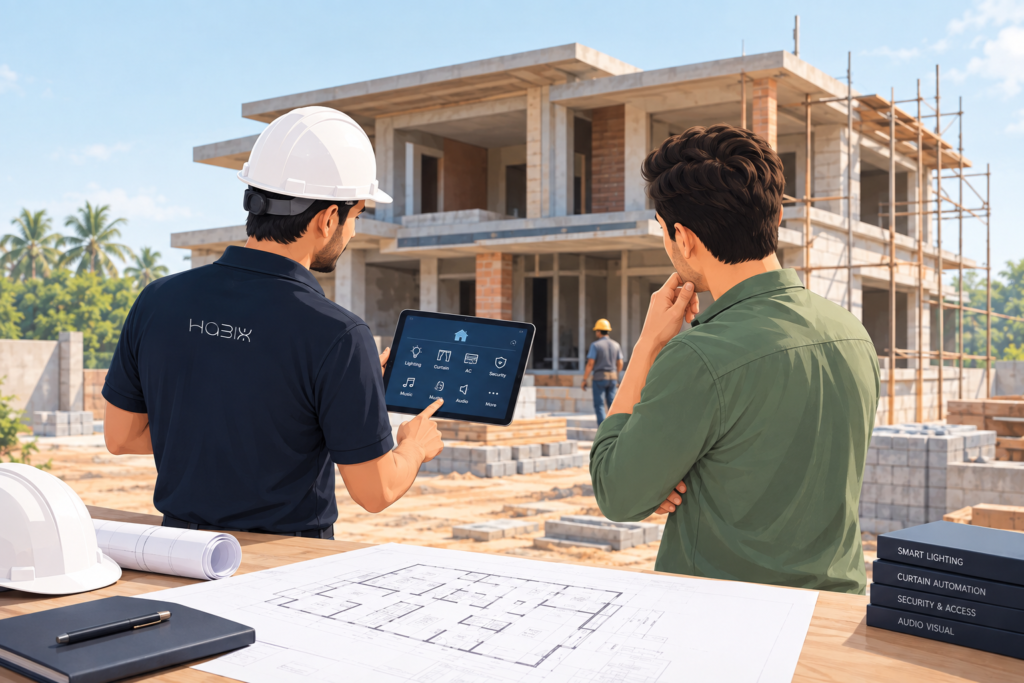
Home automation for  new house is easier to think beyond the basic electrical and interior requirements. If you are considering home automation for a new house, planning it during the early stages of the project can make the installation more organised and easier to coordinate with the rest of the work. Home automation can bring together different parts of your home, including lighting, curtains, climate control, security, entertainment and access. The important part is not simply choosing smart devices, but deciding what you want to automate and how those systems should work together. When Should You Start Planning Home Automation For New House? The best time to start discussing home automation is during the design and electrical planning stage of your new home, before the electrical work is finalised. You do not need to select every product or automation feature on the first day of construction. However, discussing your requirements early gives the automation team enough time to study the floor plan and coordinate with your architect, interior designer and electrical team. A typical planning process can look like this: House Design → Automation Planning → Electrical Planning → Installation → Configuration Starting early also gives you more time to compare different solutions and decide which areas of the house actually need automation. What Should Be Planned Before Electrical Work? Home automation electrical planning is not limited to deciding which smart products you want to install. The location of switches, control panels, sensors, curtain motors, access devices and network equipment can all be considered as part of the overall house plan. Lighting and Switches Lighting is usually one of the first areas homeowners consider when planning a smart home. Instead of treating every light as an individual device, you can decide which lights should work together and where different controls should be placed. For example, a living room could have different lighting scenes for everyday use, entertaining guests or watching a movie. Bedrooms, corridors and other areas can also be planned according to how you use them. Discussing these requirements before the electrical work is completed can help determine suitable switch locations and the infrastructure required for the chosen system. Curtain and Blind Automation If you are interested in automated curtains or blinds, it is better to consider them while the windows, ceiling details and electrical points are being planned. The curtain type, motor position, power requirement and control method can be discussed in advance. This can help the automation installation fit neatly into the overall interior design instead of requiring changes after the interiors are finished. AC and Climate Control Climate control can also be included in your home automation plan. Depending on the equipment and automation system, you may be able to integrate control of selected AC or climate-related functions. It is useful to decide which rooms need this type of control before the electrical and interior work is completed. This gives the automation team a clearer idea of the equipment and integration requirements. Security and Access Security and entrance systems are another area worth planning early. Depending on your requirements, a home automation project may include digital locks, video door phones, alarm systems, door and window sensors, gate automation or other access solutions. Planning these requirements together can make it easier to decide where devices should be installed and how they should interact with the rest of the home. Network and Connectivity A connected home also depends on suitable network infrastructure. When planning a smart home, consider where Wi-Fi access points, network equipment and other connectivity requirements may be needed. The requirements can vary considerably between an apartment, an independent house and a large villa. The network should therefore be planned around the size and layout of the home and the number of connected systems you expect to use. Why Is Early Planning Important? The biggest benefit of planning home automation during construction is coordination. Your automation requirements can be considered alongside the electrical, interior and architectural plans instead of being treated as an addition at the end of the project. Early planning can help with decisions such as switch and control locations, sensor positions, power requirements, network points and curtain motor locations. It can also reduce the need for unnecessary changes once painting, false ceilings and other interior work have been completed. More importantly, early planning gives you time to understand your options. You can decide which features are genuinely useful for your home instead of selecting products quickly when construction is almost finished. What If Your House Is Already Under Construction? If construction has already started, that does not automatically mean home automation is no longer possible. The available options depend on the current stage of the project, the existing electrical work and the features you want to add. A home automation professional can review the house plan and current infrastructure and suggest an approach based on the project. For a new house, a wired system may be considered where suitable infrastructure can be planned from the beginning. Wireless solutions can also be useful in certain situations, while some projects may benefit from a combination of wired and wireless technologies. If you are trying to understand the difference between these approaches, you can read our guide on Wired vs Wireless Home Automation: Which Is Better for Your Home? Do You Need to Automate the Entire House? Not necessarily. A home automation system for a new home does not have to include every room and every electrical device. You can prioritise the areas that are most useful to you and plan the system around your lifestyle. For example, you may initially focus on living room lighting, bedroom curtains, main door access, gate automation, security, AC control or home entertainment. Other areas can be considered based on your requirements and the system’s ability to support future expansion. The goal should be to create a home that is easier and more convenient to manage, rather than simply adding as many smart devices as possible. A Simple Home

When Should You Plan Home Automation for New House? Read More »

wired-vs-wireless-home-automation-which-is-better-for-your-home

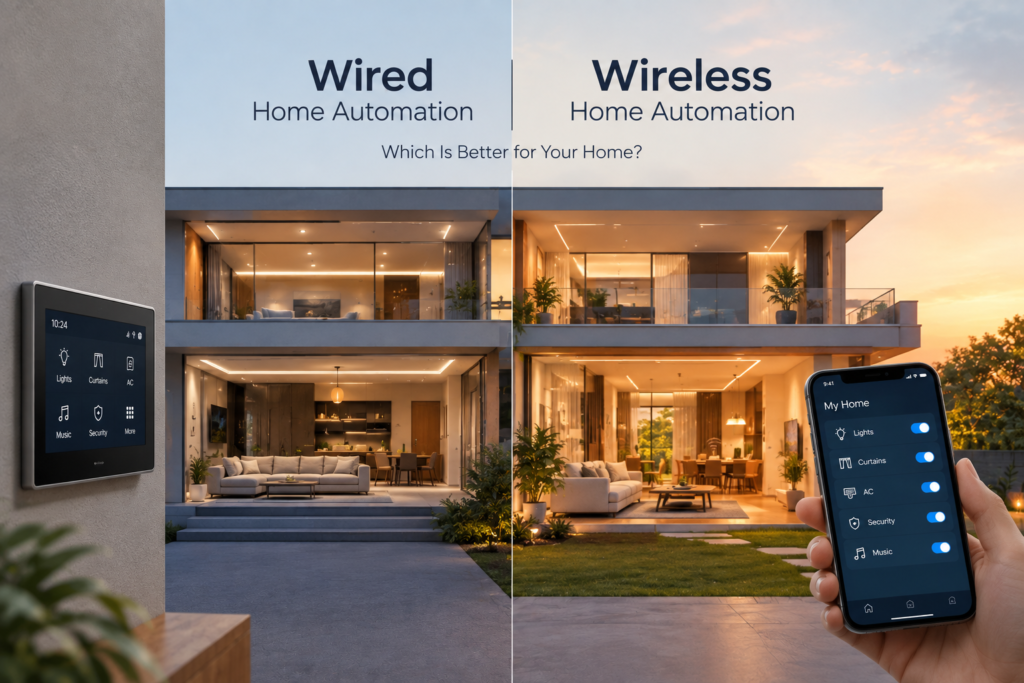
Wired vs Wireless Home Automation: Which Is Better for Your Home?

Choosing a home automation system is not simply about deciding which smart devices you want. One of the first decisions is how those devices will communicate with the automation system  through dedicated wiring, wireless communication, or a combination of both. So, wired vs wireless home automation, which is better? There is no single answer that works for every home. The right choice depends on factors such as whether your home is still under construction, the level of automation you need, the existing electrical infrastructure, future expansion plans, and how much installation work is practical. In this guide, we’ll compare wired and wireless home automation systems and help you understand which approach may be more suitable for your home. What Is Wired Home Automation? A wired home automation system uses physical wiring to connect automation components such as controllers, sensors, switches and other devices. The wiring and control infrastructure are planned as part of the home’s electrical and automation design. This makes wired systems particularly suitable for new homes and villas where automation can be considered during the planning and construction stage. Instead of relying primarily on wireless communication between devices, the system uses dedicated connections for communication and control. Wired automation is commonly considered when: A home is being newly constructed Electrical and automation planning can be done in advance The homeowner wants extensive automation Multiple systems need to work together Long-term reliability is a priority The automation system needs to support a larger installation The exact architecture depends on the automation platform and project requirements. What Is Wireless Home Automation? Wireless home automation allows compatible smart devices to communicate without running dedicated control wiring between every device. Depending on the system, devices may communicate using technologies such as Wi-Fi, Zigbee, Z-Wave, Bluetooth or other wireless protocols. This can make wireless automation particularly convenient when automation is being added to an existing home, where opening walls or making extensive wiring changes may not be practical. Wireless solutions can also provide flexibility when adding or changing individual devices over time. Wired vs Wireless Home Automation: Key Differences The most useful way to compare the two is to look at how each approach fits into a real home project. INSTALLATION WIRED home automation WIRELESS home automation Requires planned cabling Requires less dedicated control wiring BEST SUITED FOR WIRED home automation WIRELESS home automation New construction and major projects Existing homes and retrofit projects INITIAL PLANNING WIRED home automation WIRELESS home automation  Needs to be considered early Can often be added later RELAIABILITY WIRED home automation WIRELESS home automation Dedicated connections can provide consistent communication Depends on wireless network and environment FLEXIBILITY WIRED home automation WIRELESS home automation  Requires more planning for changes communication Easier to add or relocate compatible devices CIVIL WORK WIRED home automation WIRELESS home automation  May involve more installation work Usually involves less structural work SCALABILITY WIRED home automation WIRELESS home automation Can be designed for extensive automation Can be expanded depending on system architecture LONG TERM PLANNING WIRED home automation WIRELESS home automation  Strong option for planned automation Useful for phased automation The important point: neither approach is automatically better for every property. The better choice is the one that matches your home’s construction stage, automation requirements and long-term plans. Advantages of Wired Home Automation 1. Designed into the home from the beginning For a new home, automation can be considered alongside electrical, lighting, networking and interior planning. This allows the system architecture to be planned before construction is completed rather than trying to accommodate automation afterwards. 2. Suitable for larger automation projects If you want to integrate several areas of your home — such as lighting, curtains, climate control, entertainment and security — a properly planned wired architecture can be a strong option. 3. Consistent communication Because devices can communicate through dedicated physical connections, wired systems are less dependent on wireless signal conditions between devices. However, overall system reliability still depends on the quality of the design, installation and equipment. 4. Better suited to long-term planning For a new home, automation can be considered alongside electrical, lighting, networking and interior planning. This allows the system architecture to be planned before construction is completed rather than trying to accommodate automation afterwards. Advantages of Wireless Home Automation 1. Easier for existing homes One of the biggest advantages of wireless automation is that it can reduce the need for extensive new control wiring. This can make it a practical option for homeowners who want to automate an already completed home. 2. Less disruption during installation Depending on the system, wireless devices can often be installed without significant changes to walls or other finished surfaces. That can be especially useful when the home’s interiors are already complete. 3. Flexible expansion Wireless systems can make it easier to add compatible devices or extend automation to additional areas over time. The actual level of flexibility depends on the technology and system architecture being used. 4. Suitable for phased automation You don’t necessarily have to automate everything at once. A suitable wireless system can allow homeowners to start with selected areas and expand later. Wired vs Wireless Home Automation for a New Home If you’re building a new house, wired automation deserves serious consideration. The reason is simple: the planning stage gives you an opportunity to integrate automation infrastructure with the electrical and interior design instead of trying to retrofit it later. For example, if you want automated lighting, curtains, climate control and centralized control, these requirements can be discussed before electrical work and interior finishes are finalized. This doesn’t mean every new home needs to use a completely wired system. This doesn’t mean every new home needs to use a completely wired system. The right architecture depends on: The size and layout of the home The number of systems being automated Desired level of centralized control Future expansion plans Preferred technology Project budget Electrical and network planning Planning early is more important than simply choosing wired over wireless. If you’re constructing a

Wired vs Wireless Home Automation: Which Is Better for Your Home? Read More »