
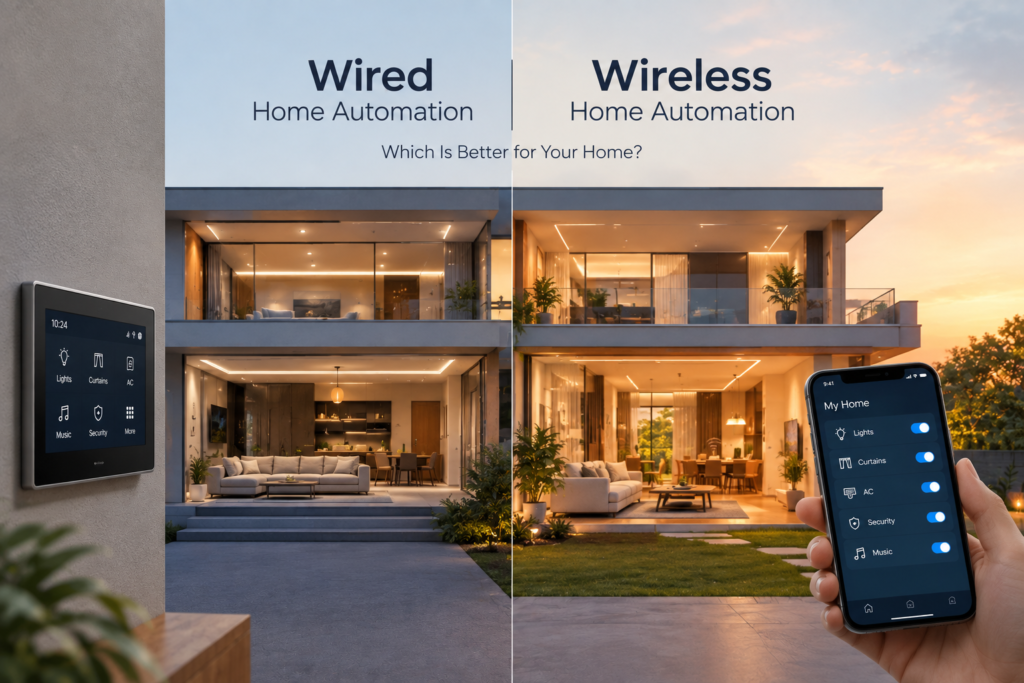
Choosing a home automation system is not simply about deciding which smart devices you want. One of the first decisions is how those devices will communicate with the automation system through dedicated wiring, wireless communication, or a combination of both.
So, wired vs wireless home automation, which is better?
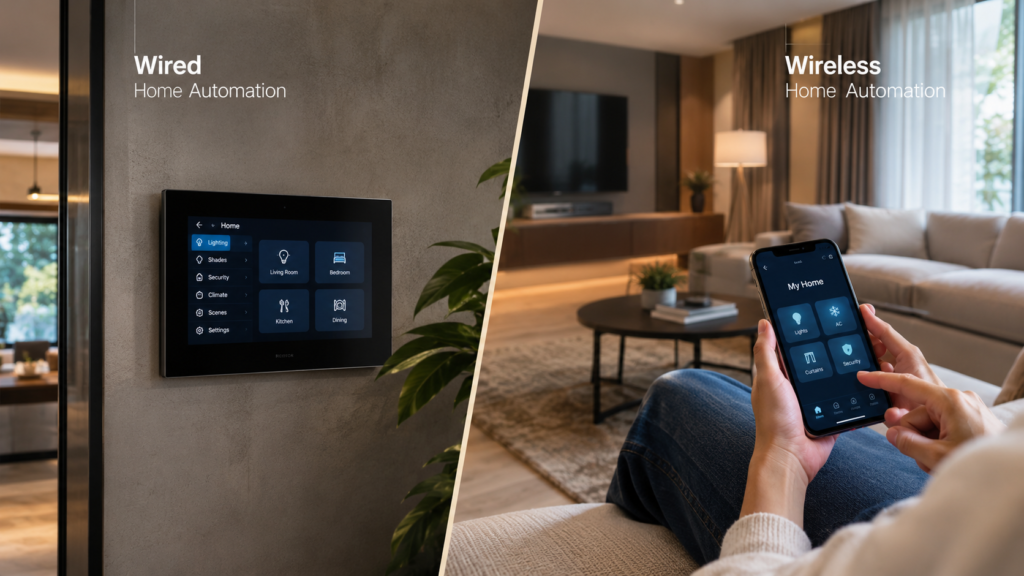
There is no single answer that works for every home. The right choice depends on factors such as whether your home is still under construction, the level of automation you need, the existing electrical infrastructure, future expansion plans, and how much installation work is practical.
In this guide, we’ll compare wired and wireless home automation systems and help you understand which approach may be more suitable for your home.
What Is Wired Home Automation?
A wired home automation system uses physical wiring to connect automation components such as controllers, sensors, switches and other devices.
The wiring and control infrastructure are planned as part of the home’s electrical and automation design. This makes wired systems particularly suitable for new homes and villas where automation can be considered during the planning and construction stage.
Instead of relying primarily on wireless communication between devices, the system uses dedicated connections for communication and control.
Wired automation is commonly considered when:
- A home is being newly constructed
- Electrical and automation planning can be done in advance
- The homeowner wants extensive automation
- Multiple systems need to work together
- Long-term reliability is a priority
- The automation system needs to support a larger installation
The exact architecture depends on the automation platform and project requirements.
What Is Wireless Home Automation?
Wireless home automation allows compatible smart devices to communicate without running dedicated control wiring between every device.
Depending on the system, devices may communicate using technologies such as Wi-Fi, Zigbee, Z-Wave, Bluetooth or other wireless protocols.
This can make wireless automation particularly convenient when automation is being added to an existing home, where opening walls or making extensive wiring changes may not be practical.
Wireless solutions can also provide flexibility when adding or changing individual devices over time.
Wired vs Wireless Home Automation: Key Differences
The most useful way to compare the two is to look at how each approach fits into a real home project.
INSTALLATION
Requires planned cabling
Requires less dedicated control wiring
BEST SUITED FOR
New construction and major projects
Existing homes and retrofit projects
INITIAL PLANNING
Needs to be considered early
Can often be added later
RELAIABILITY
Dedicated connections can provide consistent communication
Depends on wireless network and environment
FLEXIBILITY
Requires more planning for changes communication
Easier to add or relocate compatible devices
CIVIL WORK
May involve more installation work
Usually involves less structural work
SCALABILITY
Can be designed for extensive automation
Can be expanded depending on system architecture
LONG TERM PLANNING
Strong option for planned automation
Useful for phased automation
The important point: neither approach is automatically better for every property.
The better choice is the one that matches your home’s construction stage, automation requirements and long-term plans.
Advantages of Wired Home Automation
1. Designed into the home from the beginning
For a new home, automation can be considered alongside electrical, lighting, networking and interior planning.
This allows the system architecture to be planned before construction is completed rather than trying to accommodate automation afterwards.
2. Suitable for larger automation projects
If you want to integrate several areas of your home — such as lighting, curtains, climate control, entertainment and security — a properly planned wired architecture can be a strong option.
3. Consistent communication
Because devices can communicate through dedicated physical connections, wired systems are less dependent on wireless signal conditions between devices.
However, overall system reliability still depends on the quality of the design, installation and equipment.
4. Better suited to long-term planning
For a new home, automation can be considered alongside electrical, lighting, networking and interior planning.
This allows the system architecture to be planned before construction is completed rather than trying to accommodate automation afterwards.
Advantages of Wireless Home Automation
1. Easier for existing homes
One of the biggest advantages of wireless automation is that it can reduce the need for extensive new control wiring.
This can make it a practical option for homeowners who want to automate an already completed home.
2. Less disruption during installation
Depending on the system, wireless devices can often be installed without significant changes to walls or other finished surfaces.
That can be especially useful when the home’s interiors are already complete.
3. Flexible expansion
Wireless systems can make it easier to add compatible devices or extend automation to additional areas over time.
The actual level of flexibility depends on the technology and system architecture being used.
4. Suitable for phased automation
You don’t necessarily have to automate everything at once. A suitable wireless system can allow homeowners to start with selected areas and expand later.
Wired vs Wireless Home Automation for a New Home
If you’re building a new house, wired automation deserves serious consideration.
The reason is simple: the planning stage gives you an opportunity to integrate automation infrastructure with the electrical and interior design instead of trying to retrofit it later.
For example, if you want automated lighting, curtains, climate control and centralized control, these requirements can be discussed before electrical work and interior finishes are finalized.
This doesn’t mean every new home needs to use a completely wired system.
This doesn’t mean every new home needs to use a completely wired system.
The right architecture depends on:
- The size and layout of the home
- The number of systems being automated
- Desired level of centralized control
- Future expansion plans
- Preferred technology
- Project budget
- Electrical and network planning
Planning early is more important than simply choosing wired over wireless.
If you’re constructing a new home, discuss automation during the planning stage rather than waiting until the interiors are completed.
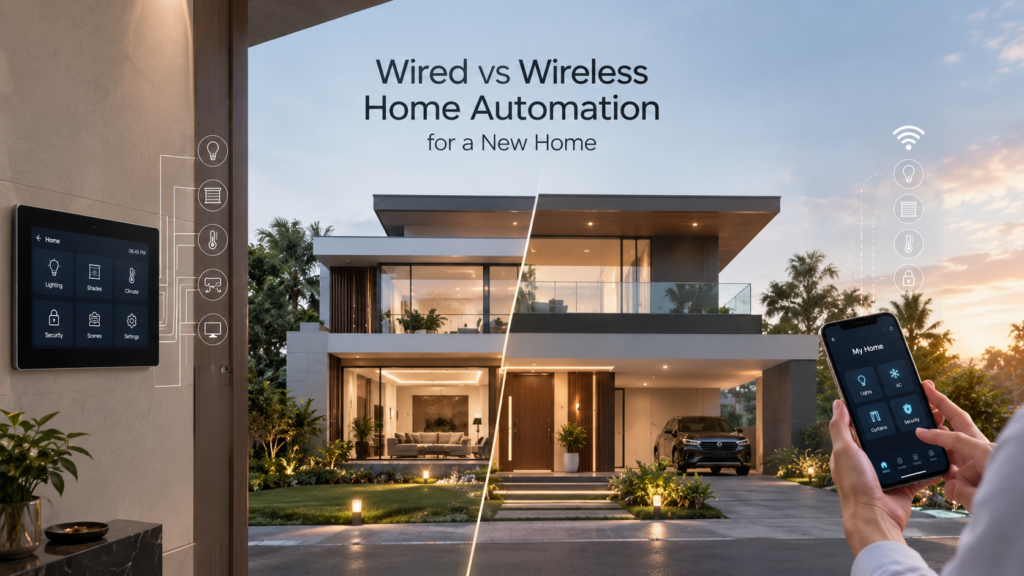

Wired vs Wireless Home Automation for an Existing Home
For an existing home, wireless automation can be attractive because extensive new control wiring may not be practical.
Instead of opening finished walls or making significant changes to the property, compatible wireless devices can potentially be integrated into the existing environment.
However, wireless does not automatically mean “plug it in and you’re done.”
A professional installation still needs to consider:
- Wireless coverage
- Network infrastructure
- Device compatibility
- Power requirements
- System integration
- Future expansion
- Overall reliability
For some existing homes, a hybrid approach may also make more sense.
Can Wired and Wireless Home Automation Work Together?
Yes, depending on the automation platform and system design.
A home automation project doesn’t always have to be completely wired or completely wireless.
A hybrid approach can combine wired infrastructure where it provides the most value with wireless devices where flexibility or retrofit installation is more practical.
For example, a project might use a robust wired backbone for core automation while incorporating wireless devices in areas where additional cabling isn’t practical.
This approach can be useful when the homeowner wants both structured infrastructure and installation flexibility.
The important thing is to design the complete system as one architecture rather than randomly combining different products.
Which Home Automation System Should You Choose?
Instead of asking:
“Is wired better than wireless?”
ask:
“Which approach is better suited to my home?”